
Description
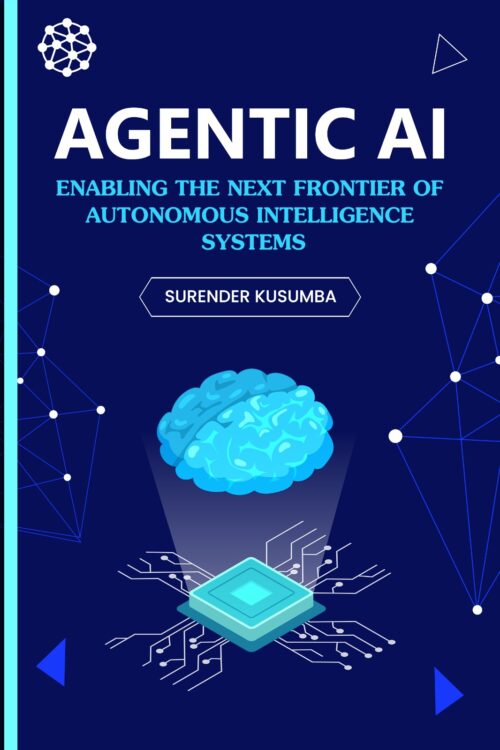
Artificial Intelligence has evolved significantly, but most traditional AI systems remain reactive, responding to inputs without long-term awareness or independent goals. This book introduces Agentic AI as a new paradigm where AI systems possess agency—the ability to pursue objectives, make decisions, adapt behavior, and operate continuously in dynamic environments. Unlike task-specific models, agentic systems demonstrate persistence, contextual awareness, and intentional action. The book examines Agentic AI from a systems-level perspective, integrating theoretical foundations, architectures, learning mechanisms, governance, and real-world operational challenges. It is designed for researchers, engineers, policymakers, and ethicists interested in autonomous systems and responsible AI development. The text avoids speculative claims and instead emphasizes scientific rigor, evidence-based reasoning, and practical system design. Drawing from fields such as cognitive science, control theory, distributed systems, and software engineering, the book places Agentic AI within a broader scientific framework. Early chapters focus on foundational concepts, while later sections explore multi-agent systems, governance, cyber-physical integration, and societal implications. The book argues that agency is necessary for advanced autonomy but is not equivalent to artificial general intelligence. Ultimately, it highlights the importance of balancing intelligence, autonomy, and governance to ensure the safe and responsible future of AI.
ABOUT THE AUTHOR
Surender Kusumba Surender Kusumba is a technology professional and researcher with expertise spanning artificial intelligence systems, distributed computing, cloud platforms, and enterprise software engineering. His work focuses on the design, deployment, and governance of large-scale intelligent systems, with particular emphasis on autonomy, reliability, safety, and ethical responsibility. With hands-on experience across system architecture, automation, and operational platforms, Surender has worked on complex, production-grade environments where software reliability, scalability, and compliance are critical. His professional background bridges theory and practice, enabling him to approach advanced AI topics from both an engineering and a governance perspective. Surender’s research interests center on agentic artificial intelligence, autonomous decision-making systems, and the socio-technical challenges introduced by learning and adaptive systems. He is particularly interested in how autonomy reshapes accountability, risk management, and trust in real world deployments. His work integrates concepts from systems engineering, control theory, ethics, and policy to address the emerging demands of responsible AI. This book reflects his commitment to treating Agentic AI not merely as a technical innovation, but as an evolving infrastructure that must be designed with rigor, transparency, and long-term societal impact in mind. By combining theoretical foundations with engineering discipline and governance frameworks, Surender aims to contribute to the development of autonomous systems that are both powerful and trustworthy.



Reviews
There are no reviews yet.